Feeling overwhelmed by debt and don’t know where to start? You’re not alone! Many people carry balances on multiple credit cards, personal loans, and even student loans, and struggle to make any meaningful progress. Sometimes interest rates are so high that it seems like you’re barely making progress on the balance before your interest compounds again! There is a way to accelerate your debt-free journey. It is by utilizing the debt avalanche method to pay off your debt. This approach focuses on interest rates by targeting debts that cost you the most. The avalanche strategy to debt repayment can save you a lot of money and reduce the amount of time it takes to become debt-free.
Related Posts:
- 9 Steps To Become Debt Free
- Simple Ways To Increase Your Monthly Debt Payment
- How To Calculate Your Debt-to-Income Ratio
What Is The Debt Avalanche Method
Like the debt snowball method, the debt avalanche method is a structured approach to help guide you as you are paying off debts. What makes the avalanche method different is that it focuses on eliminating your high-interest debts first.
By making minimum payments on all your debts and putting any extra money you can towards the debt with the highest interest rate, you minimize the amount of interest paid over time.
While the debt snowball method prioritizes momentum, the debt avalanche method prioritizes long-term savings.

Why You Should Use The Debt Avalanche Method
The debt avalanche method can be a smart decision for your finances if you are already committed to a focused and logical payoff strategy. Here are some reasons why the method may be right for you:
- You want to save money – If your goal is to minimize the total interest paid, you will want to target your high-interest debts first.
- Motivated by a shortened payoff timeline – Since this method targets lowering the amount of interest paid, there is potential to reach your debt-free goal faster.
- Driven purely by data – If you are all about the numbers and efficiency, this method is perfect for you!
- Disciplined with managing your money – When you are disciplined with your budgeting, expense tracking, and are fully committed to reducing the amount of interest you pay back, you will succeed with this method!
If your overall financial goal is to become debt-free while also minimizing the amount of interest you pay back over time, the debt avalanche method will help you achieve that goal fast.
Pros & Cons of Using The Debt Avalanche Method
As with any tool or strategy used within personal finance, not every aspect is for every person. Here are some pros and cons that can help you decide if the debt avalanche payoff method is the one for you.
Pros:
- Interest Saved: Since you are targeting the higher interest debts, you are paying less interest over time
- Debt Eliminated Faster: High interest rate debts can compound quickly! Tackling these debts first helps to accelerate your payoff progress
- Mathematical: For some, it’s hard to argue with the logic of numbers.
- Budgeting Discipline Is Encouraged: To make sure that you are paying the least amount of interest back, you must consistently track interest rates, payments, and your budget.
Cons:
- Emotional Wins Are Delayed: As you are paying down your high-interest debts, you won’t see victories as fast, especially if your high-interest debt also has a large balance.
- Consistency Is Required: If you end up missing a payment or get off track, it can reduce the effectiveness of this method.
- Can Become Overwhelming: If you have a lot of debts, and the debt with the highest interest rate is also a larger balance, your motivation could wane without any significant visible progress.
If you are someone who is motivated to continue on your debt-free journey from the feel-good wins of paying off your debt, using the debt avalanche method to pay off debt may not be suited for you.

How To Start Using The Debt Avalanche Method
Now that you’ve decided to use the debt avalanche method, here are the steps you’ll need to take to tackle your debt and begin to improve your financial health.
1 – List Out All Your Debts
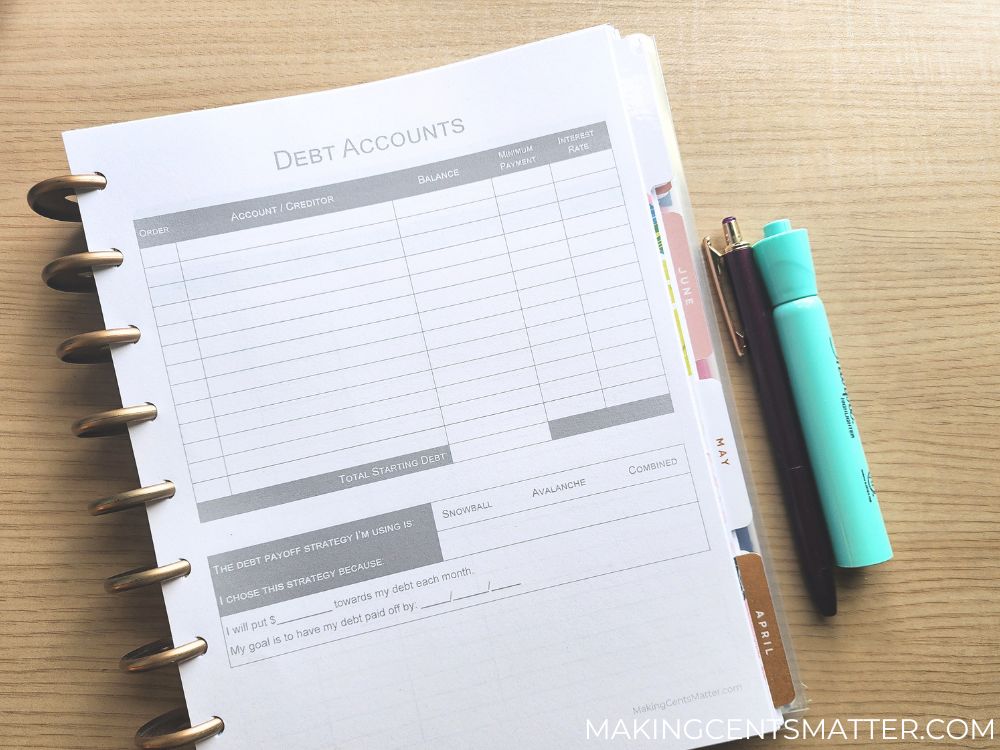
Create a complete list of all the debts you currently have. Don’t forget to write down:
- The creditor’s name,
- The total balance,
- Your minimum monthly payment,
- Interest rate of your debt
This may seem like a tedious step, but it is crucial for setting up your debt payoff plan. It helps you to see the full picture of your total debt.
For this step, you can use the free debt payoff tracker I have in my Resource Library!
2 – Order your Debts By The Interest Rate
With your list of debts in front of you, sort the list by interest rate, from highest to lowest. Disregard your balance! For this method, you will only be focused on minimizing the amount of interest you pay.
3 – Create A Budget For Minimum Payments (+ Extra)
First, you want to make sure that your budget can cover the minimum payments of your debts.
Next, you want to review your budget to find any extra funds that you can add to the minimum payment of your highest interest debt. Whether it is an extra $5, $25, $50, or $100, any extra amount you can add makes a difference!
You can review your budget and expenses to cut out any non-essentials to help increase what you are adding to your minimum debt payment. Temporarily redirecting that money towards your debt will help speed up your progress!

4 – Focus On The Debt With The Highest Interest Rate
As you make minimum payments on your other debt accounts, focus all the extra money you can on your top-priority debt.
Once that balance is zero, you can move all the money you paid every month to the debt with the next highest interest rate.
5 – Repeat Until All Your Debts Are Paid Off
Keep the process going until every debt you have is paid off! As you eliminate a debt, the amount of money you have freed up increases, creating what can feel like an avalanche of progress towards being debt-free, all while keeping the interest you paid low!

An Example Of How To Use The Debt Avalanche Method
Following the steps outlined above, list out all your current debts. Let’s say the following is what you have as your current debts:
- Credit Card A: $3,000 balance, 22% Interest Rate, $90 minimum monthly payment
- Personal Loan: $1,200 balance, 18% Interest Rate, $35 minimum monthly payment
- Car Loan: $5,000 balance, 6% Interest Rate, $100 minimum monthly payment
- Student Loan: $8,000 balance, 4.5% Interest Rate, $150 minimum monthly payment
You are currently paying $375 a month total in minimum payments, and you find an extra $25 from your budget that you can add to your debt payments. The extra money can come from cancelling subscriptions, eating out once every two weeks, or temporarily reducing miscellaneous expenses.
This means you would pay an additional $25 each month towards Credit Card A, for a total of $105 paid each month until the balance is $0.
Once Credit Card A is paid off, you can add the $105 you were paying to the Personal Loan minimum payment, now paying $140 a month on it. The following image shows how your minimum payments avalanche as you pay off your debts.

As you move down the line, you increase the amount that you pay each month. This speeds up your timeline since your higher balances don’t continue to accumulate interest. In the end, tackling your debts with the higher interest rates first reduces the amount of interest compounding. This is what saves you money in the long run!
Final Thoughts: The debt avalanche payoff method is a strategic and mathematical way to pay off your debt.
By utilizing this powerful debt payoff strategy, you can take control of your finances while making progress on long-term financial goals. It doesn’t offer the quick boost of motivation like the debt snowball method, but it reduces the overall interest paid and improves your overall financial health.

Leave a Reply