Paying off debt is one of the most powerful steps you can take toward improving your financial health, but for many, it can feel overwhelming. Many people start their debt-free journey feeling motivated, only to lose that momentum because they are unsure which strategy actually works best for their situation. No matter what type of debt you are dealing with, having a clear debt payoff strategy can help you stay focused and motivated throughout your debt-free journey.
Two of the most popular methods for becoming debt-free are the debt snowball and debt avalanche methods. Each approach works slightly differently and appeals to different personalities, budgeting styles, and financial situations. While both approaches provide a structured plan for paying off debt, they prioritize your debts differently.
One method focuses on motivation and momentum, while the other focuses on saving money on interest. Both methods, when used effectively, will help you become debt-free, improve your financial health, and help you create healthier money habits over time. Choosing the right method for your situation can make the difference between staying committed to your debt payoff goals or giving up halfway through the process.
Below, we’ll break down which strategy is right for you by understanding the key differences between the methods, advantages, and disadvantages of each method, as well as the steps needed to determine which is best for you can help you choose the approach that will support your financial goals and personal habits. Whether you are brand new to budgeting for beginners or looking for better money management strategies, this guide will help you confidently choose the debt payoff method that fits your lifestyle.
Related Posts:
- Mistakes To Avoid While Paying Off Debt
- How To Painlessly Increase Your Debt Payment
- How Your Emotions Are Affecting Your Spending Decisions

What Is The Debt Snowball Method
The debt snowball method focuses on paying off your debts from smallest to largest balance, regardless of interest rate. You continue making minimum payments on all your debts while putting every extra dollar toward the smallest debt balance, creating quick wins that help build momentum and confidence during your debt-free journey.
With this approach, you will:
- List all your debts from smallest balance to largest balance.
- Make minimum payments on all debts.
- Put any extra money toward the smallest debt.
- Once the smallest debt is paid off, roll that payment into the next smallest debt.
- Continue the process until all debts are eliminated.
If you’d like a detailed walkthrough of how the debt snowball works, be sure to check out our complete guide to the debt snowball method.
What is the Debt Avalanche Method
The debt avalanche method focuses on paying off debts based on interest rates rather than balances. Like the snowball method, you continue making minimum payments on all other debts, while putting your extra money toward one target debt at a time. This helps you minimize the total amount of interest paid, ultimately saving money over time.
With this approach, you:
- List all debts from the highest interest rate to the lowest interest rate.
- Make minimum payments on all debts.
- Direct extra money toward the debt with the highest interest rate.
- Once that debt is paid off, move to the next highest interest rate.
- Continue until all debts are eliminated.
For a more detailed explanation of this strategy, check out our complete guide to the debt avalanche method.
Key Differences Between the Debt Snowball and Debt Avalanche Methods
Although both methods aim to help you become debt-free, the way they approach debt payoff is very different.
The Debt Snowball Focuses on Building Motivation & Momentum
The debt snowball method prioritizes emotional wins. Paying off smaller balances quickly helps you feel successful early in the process, and those small victories can boost confidence and motivation, especially if you are someone who struggles with consistency.
That is why this method is often recommended for budgeting for beginners because it creates visible progress quickly.
The Debt Avalanche Focuses on Saving Money In The Long-Term
The debt avalanche method prioritizes financial efficiency. By attacking fast-growing, high-interest debt first, you reduce the amount of interest accumulating over time. This makes the avalanche method attractive for people focused heavily on personal finance management and maximizing efficiency.
Why Choosing The Right Method Matters
Many people assume that debt payoff is simply about making larger payments. While paying extra toward debt is important, the strategy you use matters much more. The right debt payoff method is the one that helps you stay consistent, motivated, and focused during what can sometimes be a long financial journey.
Without a clear plan in place, it becomes easier to fall back into unhealthy money habits, skip extra payments, or lose sight of your goals. Having a structured debt payoff strategy helps to give your finances direction and simplifies your decision-making. Instead of wondering which debt to tackle first every month and sporadically sending extra money to various debts, you follow a proven system.
Having a strategy also helps reduce stress, since financial overwhelm often comes from uncertainty. When you know exactly where your extra money is going and why, your financial decisions begin to feel more intentional and manageable.
Most importantly, choosing a debt payoff strategy that matches your personality can help you stick with your plan long enough to see real results. The best method is not always the one that makes the most mathematical sense. Often, the best method is the one you can realistically follow right up to the finish line.
Advantages of Each Debt-Payoff Method
Debt Snowball Method Advantages
The debt snowball remains one of the most popular debt payoff strategies because it focuses heavily on behavior and motivation. Eliminating a small debt within a short period of time helps with accomplishment
This method:
- Provides Quick & Easy Wins: Paying off smaller balances helps you see early progress, helping you remain motivated.
- Helps Build Financial Confidence: Many people start by feeling overwhelmed, but as accounts disappear, your confidence in your financial habits increases.
- Reduces Stress By Simplifying Your Finances: Each debt you eliminate is one less payment you have to track; fewer payments help make personal finance feel less stressful and much more manageable.
- Encourages Long-Term Habits Through Consistency: Consistency remains one of the most important habits you can develop for managing your finances. When you see your progress each month, it helps you remain committed to your goals.
- Easier for Beginning Budgeters: Since this method focuses on balances, it feels much simpler & approachable for those who are new to managing their finances.
Advantages of the Debt Avalanche Method
The debt avalanche appeals to people who want to maximize efficiency and minimize how much they pay in interest.
- Saves More Money On Interest: The debt avalanche method results in less interest paid overall, which could mean saving hundreds, or even thousands of dollars throughout your debt-payoff journey.
- Debt-Free Becomes Efficient: Since your overall interest is reduced, more of your payment goes towards your principal balances, allowing you to make progress much faster.
- Makes The Most Of Extra Payments: With every additional dollar paid towards your most expensive debt, your payments are working harder to save money in the long run.
- Appeals To Logic-Minded Budgeters: If you’re motivated by numbers, efficiency, and long-term financial gains, this method may feel much more rewarding.
- Strengthens Personal Finance Skills: This method helps you understand your interest rates, loan structures, and overall financial strategy, which helps to improve your financial health in the long-term.

Disadvantages of Paying Off Debt With These Methods
Disadvantages of the Debt Snowball Method
Although the debt snowball has many strengths, it isn’t perfect.
- May Pay More In Interest: Because your balances are prioritized, you may end up paying more in interest over time.
- Not Always The Most Efficient: From a purely mathematical standpoint, if you are not prioritizing the debt that is adding the most interest over time, your repayment timeline could be extended.
- Larger, High-Interest Debts Remain Longer: If you leave a high-balance & high-interest debt for later, like a credit card, this can feel much more overwhelming when you eventually reach it.
Disadvantages of the Debt Avalanche Method
While mathematically efficient, the debt avalanche may not work for everyone.
- Progress Often Feels Slow: If you are tackling a larger balance debt that also has a high interest rate, it could be months before you completely pay off the account, which feels discouraging.
- Motivation Is Harder To Maintain: Without easy wins early in your debt-free journey, you start to feel like your hard work isn’t producing results. Since personal finance is both mathematical and emotional, burnout could happen more easily.
- Requires Much More Patience: The avalanche method allows for a significant payoff over time, but this method requires much more patience and long-term thinking since progress takes longer to appear. For this reason, many lose motivation before seeing the results of their hard work.

Debt Snowball vs. Debt Avalanche: Which Is Better For Your Journey?
The truth is that there is no universal answer for which method is best. The right choice depends on your financial situation, personality, and motivation style. However, the best strategy overall is always the one that helps you make consistent progress, while also helping you to stay motivated as you continue paying off your debt.
Here are some steps that can help you decide which strategy is best for you to use:
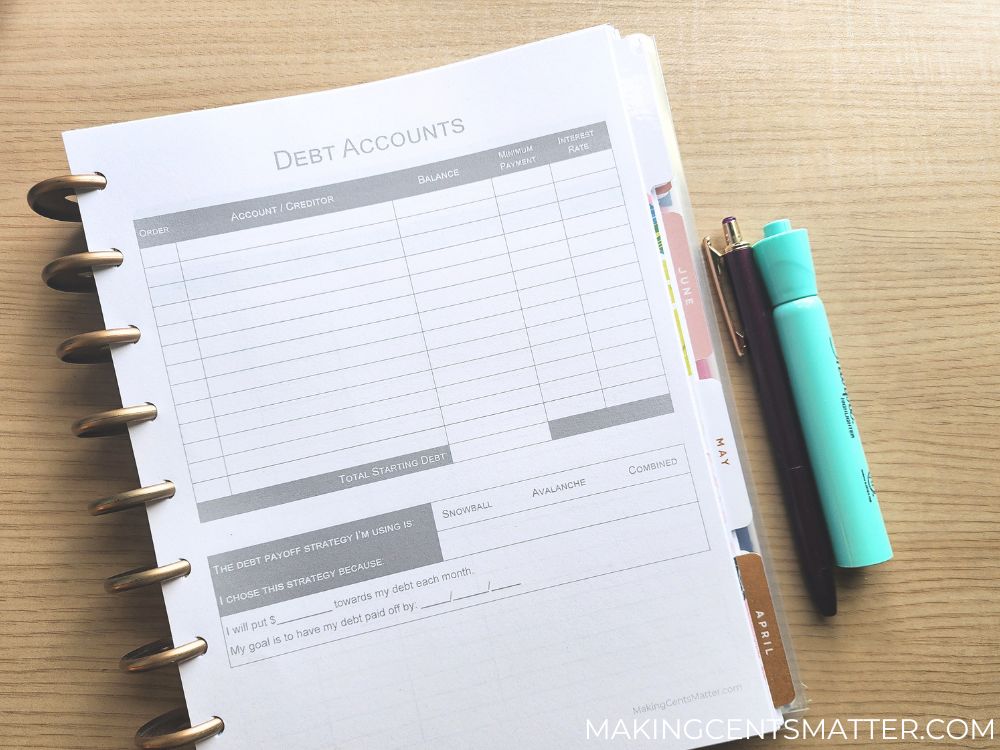
Step 1: List All Your Debts
Start by writing down each debt you have; be sure to include the:
- Balance
- Interest rate
- Minimum payment
- Due date
Using a budget printable or debt tracking worksheets can make this process much easier since organizing your debts visually helps you understand your financial picture much better.
You can find a printable to help with this in my Resource Library!
Step 2: Evaluate Your Personality
Ask yourself these questions:
- How do I naturally make decisions?
- Do I need to see visible progress & emotional rewards?
- Do I prefer mathematical efficiency as motivation?
- Will small wins motivate me?
- Do I lose momentum easily?
By answering some of the questions, it becomes very clear which method may be better suited as your payoff plan.
Step 3: Consider Your Current Financial Stress Levels
If your debt currently feels emotionally exhausting, the snowball method can help reduce your stress level faster by eliminating many smaller accounts quickly.
Have you struggled with paying off debt in the past? Or do you simply feel overwhelmed by multiple balances? Then the debt snowball may be a better fit since the quick wins will help build your confidence and create a sense of accomplishment to keep you moving forward.
If your biggest concern is one or two high-interest debts, the avalanche method may provide a greater peace of mind in eliminating the higher interest costs each month.

Step 4: Calculate Potential Savings
If you’re still not decided on what method might be the best, compare how much interest you would pay using each method. There are many debt payoff calculators online that can estimate the difference for you.
Sometimes the interest savings from the avalanche method are very minor. Other times, the savings is substantial enough to help you make a decision.
Step 5: Choose the Method You Can Stick With
The best debt payoff strategy is the one you will consistently follow. The method that keeps you motivated month after month is going to be far more effective than a perfect plan that you abandon after three months.
This may mean you need to combine the methods.
For example:
- Pay off one or two small debts first for motivation
- Then switch to the avalanche method to pay off a larger high-interest debt
Or you might prioritize high-interest debt while still celebrating smaller milestones along the way.
In the end, your debt payoff plan should support your lifestyle, motivation, and long-term goals. This is why personal finance is not a one-size-fits-all approach. Consistency always beats perfection when it comes to personal finance management.
When Should You Re-evaluate Your Debt Payoff Method?
Choosing a debt payoff strategy is not a lifelong commitment. Many things can change, like circumstances, income, and expenses, as well as your priorities over time. Taking the time to occasionally reevaluate your debt payoff strategy will help ensure that you are still on track for your financial goals.
Here are some ways to know if you need to reevaluate your debt payment plan:
- Your Motivation Has Declined: If you’ve stopped making extra payments or have started to feel discouraged, it may be time to switch your approaches. So, if you have been using the avalanche method and feel stuck, you may benefit from switching to the snowball method for some motivation, in addition to some quick payoff wins.
- Your Financial Situation Changed: Whether it’s a new job, a promotion, a side hustle, or even a reduction in expenses, each instance allows you to increase your debt payments. If your income has changed significantly, it is time to review your overall strategy.
- Interest Rates Changed: Variable interest rates can increase and decrease over time. If your interest rates have risen substantially, focusing on high-interest debt may become more important.
- You Have Already Paid Off Several Debts: As your debt balances shrink, your priorities also change. What made sense at the beginning of your debt-free journey a year ago may not be the best approach now.
- Your Financial Goals Have Changed: As you continue improving your financial health, you may shift towards building an emergency fund, saving for a home, investing, or funding other important financial goals. Your debt payoff strategy should also fit within this broader plan.

7 Tips for Success Regardless of Which Payoff Method You Choose
No matter which strategy you select, these personal finance tips can help you stay on track.
1 – Create a Budget
A realistic budget helps you identify money to direct toward debt payments. Your budget categories should reflect your budget, and no one else’s.
2 – Track Your Progress
Whether you use a debt tracker, printable worksheet, or spreadsheet, tracking your progress helps maintain motivation, and seeing your balances shrink over time helps you remain focused.
3 – Build a Small Emergency Fund
Unexpected expenses can derail your debt-free journey quickly. Even a small emergency fund helps provide financial stability and reduces reliance on credit cards.
4 – Automate Payments
Automatic payments reduce the risk of missed due dates and added late fees.
5 – Celebrate Milestones / Small Wins
Recognizing your progress & rewarding yourself when you hit certain milestones. Celebrations don’t need to cost money, and can help reinforce healthy money management habits and keep you focused on becoming debt-free.
6 – Continue Learning About Money Management
The more you improve your financial knowledge, the easier it becomes to maintain healthy money habits long term.
Whether you choose to read books, listen to podcasts, or follow trusted personal finance tips, the goal is to regularly learn about how to improve your financial management skills.
7 – Focus on Long-Term Financial Health
Debt payoff is only one part of improving your overall financial health.
Don’t forget to continue building your budgeting strategy, increase your savings accounts, and learn about how your personal spending habits can support your long-term success.

Want To Read More? Check Out:
- Beginner’s Guide To Financial Health
- How To Create A Roadmap For Your Financial Health
- How To Start Having A Positive Relationship With Money
Final Thoughts: Debt Snowball vs Debt Avalanche Isn’t One Size Fits All
Both the debt snowball and debt avalanche methods can help you successfully pay off debt and improve your overall financial situation. The right strategy depends on what motivates you, how you handle stress, your financial situation, and what kind of support you need during your debt-free journey.
Remember, there is no perfect debt payoff strategy. The best strategy is one that you can consistently follow. As your circumstances change, don’t be afraid to reevaluate your approach and make adjustments that will continue your journey. In the end, what matters most is taking action, staying consistent, and continuing to build healthy money habits that support your long-term financial freedom.
If you’re ready to take the next step in your debt-free journey, start by listing all of your debts and choosing the payoff method that feels most realistic for you. Then download a debt payoff tracker, create a plan, and begin taking action today.
Every payment you make brings you one step closer to becoming debt-free and improving your financial health for years to come.


Leave a Reply